Grief and Beginning Again

We’ve been home for two weeks, and I’m already falling behind in my average Apple Watch step count. Over the course of three months in Paris, we walked 480 miles and climbed 510,000 stairs, but who’s counting?
A few days ago, I watched the film "Midnight in Paris" and realized I knew all those streets, sidewalks and cafés. Paris really is a walking city – no wonder Parisians can consume so much bread, cheese, steak, frites, wine and chocolate and not get fat. So now, it’s back to my stationary bike, treadmill and calorie counting. And yes, I must find a clean, indoor swimming pool near my house.
Our three-month stay in Europe was life-changing. If you asked me a year ago what I’d be doing now, I couldn’t have imagined traveling around Europe and North America, preaching and teaching about dementia from the inside out. I couldn’t have imagined serving on the Association of Frontotemporal Degeneration’s Think Tank, much less keynoting their annual conference. I couldn’t have imagined writing this blog, talking with newly diagnosed individuals and their families, or leading retreats for those living with dementia. I’m beginning to wonder if something magical or miraculous happened when our transatlantic cruise ship crossed the Strait of Gibraltar at midnight on the first full moon of the spring equinox last April.
Did I shift with the lunar season? Perhaps.
While I am thankful for the gifts of my new ministry, I sometimes long for my old life. During the holidays, I really missed being a cathedral dean . My first Christmas Eve away from Trinity was one of my hardest days yet. I decided I couldn’t bear going to Midnight Mass. I didn’t want to sit through the service crying my eyes out (I’m actually a private person when it comes to shedding tears). However, I had to stay awake for my host’s annual Christmas Eve party. So, I sent everyone off to church in the building next door, and I lay down on the couch to take a nap. I was exhausted but couldn’t sleep. My legs were cramping and twitching so badly that I curled up in a fetal position for relief. I turned on the television to find the usual assortment of sentimental Christmas movies, political talk shows, the shopping channel (in French), and a rerun of "The Tonight Show Starring Jimmy Fallon" (English with French subtitles).
I lay there feeling sorry for myself, recalling Christmas Eves past. I thought about all those Christmas pageants, open houses, and midnight masses. I thought about my long kilt – the one my mom made for me when I was 14, and I still wear to this day (thanks to a few alterations). I thought about our Christmas tree adorned with my grandmother’s hand-embroidered ornaments. I thought about honey baked ham and cheese sandwiches. I thought about standing in the pulpit and sharing my Christmas sermon. I thought about that special moment when all the lights were out, the candles lit, and the congregation sang “Silent Night.” It was simply too much. I started to sob - deep and profound tears of grief that had been building up over the last year. It was the pity party of my lifetime.
After pulling myself together, I got up and decided to sneak into the cathedral for the end of the service, but then realized I didn’t have the key to the deanery. So instead, I walked out on the terrace. The night was warm and clear. It was midnight. I could hear the sound of “Silent Night” and see the flickering of candles through the stained glass windows. Standing there, all alone, in the dark, I said my prayers and prayed that Christ be born anew in me and the rest of the world. Suddenly, I heard voices and the opening of a door. Worship had ended and the celebration had begun.
Grief is a funny thing. It comes and goes, like the waves, the moon, and the seasons. As I prepare for my next round of preaching and teaching, I’m glad the holidays are over. Back in Cleveland, the days are getting longer and another chapter of the journey begins. - Tracey
Visit Tracey’s events page to see where she will speak next.
Want to request a speaking engagement? Contact us.
The Gift of Vulnerability

A painting of the Holy Family in Basilica St. Michael, Mondsee, Austria
For the past 30 years, looking for my Christmas sermon was part of my annual holiday tradition. My mother used to say that it took the place of my childhood tradition of searching for unwrapped, but carefully hidden Christmas presents. This year, I don’t have to look for a sermon, as I’m no longer preaching at Christmas. However, I do want to share with you reflections on a Christmas past that has come full circle.
During the last year of my mother’s life, I attended the Christmas party in the memory unit of Judson Park, the retirement community where my mother lived. I joined the holiday festivities with some 14 of my mother’s companions, their caregivers, and a small handful of spouses and children.
My mother’s peers were a fascinating group of women and men who, in their prime, were doctors, dentists, lawyers, nurses, therapists, college professors, business executives, sales clerks, homemakers, civic volunteers, and church leaders. Due to dementia and memory loss, they were living in a small and protected world, vulnerable and dependent on the care, compassion and respect of others.
I walked into the unit singing “We Wish You a Merry Christmas,” and then offered hugs, kisses and season’s greetings all around. My mother looked up, smiled and greeted me with her usual: “Where did you come from?” And as usual, I responded: “Mars,” as I sat down next to her.
For the following 30 minutes or so, we sipped wine and coffee, ate cookies and brownies, opened bags of candy and ornaments prepared by local school children, and listened to Christmas carols and sentimental holiday music played on the piano by a delightful Jewish cantor.
With the evening coming to a close, the pianist began the familiar refrain of “Silent Night.” I put my arm around my mom and started to sing, and so did she. I glanced around the room at this little community of women and men who probably could not have told you what they had eaten for dinner, and most of them were singing or humming as well. I saw two other daughters and one son with arms around their moms, and I realized that we all had tears in our eyes. Here we were: adult children holding our vulnerable, elderly mothers in our arms as they had held us when we were young; middle-aged children laughing, singing and playing with our aging mothers who now saw the world through the eyes of a child; grown-up children helping our mothers eat cookies and drink from their cups in the same way they had helped us when we were little.
In the singing, feeding and holding of our vulnerable mothers, we - their daughters and sons, the fruit of their wombs - were given permission to be vulnerable. After all, they were still our moms. The roles were reversed, but the honesty, vulnerability and grace of love remained. There we were – authentically ourselves in this time and space none of us ever thought we would see.
“When we were children, we used to think that when we were grown-up we would no longer be vulnerable. But to grow up is to accept vulnerability…to be alive is to be vulnerable.”
Fast forward four years…This past Sunday, I attended the Festival of Lessons and Carols at the American Cathedral in Paris. As I sat in the pew listening to Christmas readings and songs I know so well, I found myself weeping with uncontrollable tears and shaking with increasingly common tremors. Emily, my beloved partner and amazing spouse, put her arm around me and held me tight as she sang the words to “Silent Night.”
Christmas is about vulnerability. God dared to come into the world in the most vulnerable way possible – a newborn baby. No matter how you understand or explain the complexity of this mystery we call the incarnation, Christmas asserts that the very character of God is revealed in a naked, needy, dependent, gurgling, grubby, smelly, sometimes happy and sometimes cranky, defenseless baby. The infant Jesus had no more ability to care for himself than any other newborn baby, severely disabled adult, or person with advanced dementia, but that is how God chose to come among us on that first Christmas. In Jesus, God became vulnerable so that we would have the courage to be vulnerable and have compassion for the vulnerable among us.
In the incarnation, God cultivated love by becoming vulnerable, and making the Divine Self deeply seen and known, speaking his mind and sharing her heart with a weary world. In Jesus, God appeared on earth as the most weak and defenseless creature imaginable so that we would take him into our hearts and be equally courageous and vulnerable, and then to courageously care for the vulnerable among us, those with whom God is pleased to dwell.
At Christmas, I am reminded that no matter what’s going on in the world or in my own life, when we light the candles and sing “Silent Night,” if I look carefully, I see the face of God; if I listen closely, I hear the voice of God; and if I make myself vulnerable, I feel the love of God enter my heart and be born anew.
And that is my Christmas prayer for each and every one of you. May you look carefully and see the face of God in those around you, may you listen closely and hear the voice of God in those around you, may you make yourself vulnerable and feel the love of God enter your heart this Christmas, and then may you have the compassion and courage to speak out and care for the vulnerable ones with whom God is pleased to dwell.
Merry Christmas from Paris! - Tracey

The most vulnerable Jesus I’ve ever seen. Basilica St. Michael, Mondsee, Austria
The Great Interruption

A depiction of John the Baptist in the “Chrétiens d’Orient” exhibit at the Institut du Monde Arabe, Paris
Excerpts from a sermon preached at The American Cathedral, Paris, France
December 10, 2017
Alfred Delp, a 20th century German priest, executed by the Nazis for his participation in the Resistance, wrote from prison words that have stayed with me for years:
“Advent is a message that shakes us up so that we will come to know who we are and to whom we belong.”
For years, I have preached that if Jesus was a carpenter, then his cousin John the Baptist was his demolition contractor. If Jesus ushered in the dawn of a new day, then John was the alarm clock. Now I’m here to tell you that if Jesus is the way to new life, then John, whom we visit every Advent, is the great interrupter of our old lives.
Interruptions – minor or major – break into the normal state of affairs and stop the continuity of events, like a metro strike or a power outage. Interruptions can also be opportunities filled with possibilities, like an unplanned pregnancy or an unexpected job offer.
I am convinced that Christ happens in the interruptions. Though I don’t always welcome them in the moment, I believe that most interruptions are invitations of grace waking to be recognized and received.
That’s what happened when the doctor told me that I had dementia. On Easter morning – right here in this cathedral – I heard the voice of God saying: “Tracey, it’s time to welcome this interruption and transform it from an exile to an exodus, from a death sentence to a pilgrimage, from an intrusion to an invitation.”

The Very Rev. Tracey Lind at The American Cathedral in Paris
I am not suggesting that God gave me dementia. I do not believe that God gives us any illness, disease, natural disaster, or misfortune. However, as I’m learning firsthand, we can encounter God in any circumstance as the Holy One is always standing beside us. On Easter morning (of all days), John the Baptist interrupted me as a voice crying in the wilderness: “You might have dementia, but God isn’t finished with you. So prepare the way and get ready to build God a new mansion with your life.”
Wherever Jesus traveled, into villages, cities or farms, they interrupted him, “laying the sick in the marketplaces, and begging him that he might touch even the fringe of his cloak” (Mark 6:56). Did Jesus reject or refuse all these interruptions? No, Jesus saw the realm of God at hand as an interruption to be welcomed. Moreover, Jesus was an interrupter himself. He interrupted the ordinary lives of some naïve fisherman by inviting them to follow him. He disturbed unclean spirits and demons that were holding innocent people hostage. He intruded upon the profitable career of Levi, the tax collector. He interjected himself into the argument James and John were having about being the greatest.
One of the challenges and opportunities of gospel living is to make room for interruptions: to look up and stop what we’re doing when we hear, “Excuse me, I don’t mean to interrupt but….” God only knows what wonderful experience is about to happen, or what gifts might be given and received. God only knows how we might be instruments of grace, how we might ease someone’s pain or share in another’s joy, and how we might experience life more fully.
The other challenge of gospel living is to be willing to interrupt the flow of things: to interrupt when we need help or when somebody else needs help. As disciples of Christ, we’re also called to interrupt the status quo when it needs changing; and to interrupt acts of hatred, evil and oppression whenever and wherever they are found.
As you go about your daily life this Advent, try keeping your eyes open and ears attuned to the possibility of meeting Christ and seeing glimpses of God in the interruptions. And when your finely tuned plans and well-ordered routines are interrupted, try to remember that life happens in the interruptions and that God might be building (or rebuilding) in you a mansion in which Christ might come and dwell. - Tracey
Singing the Advent Blues
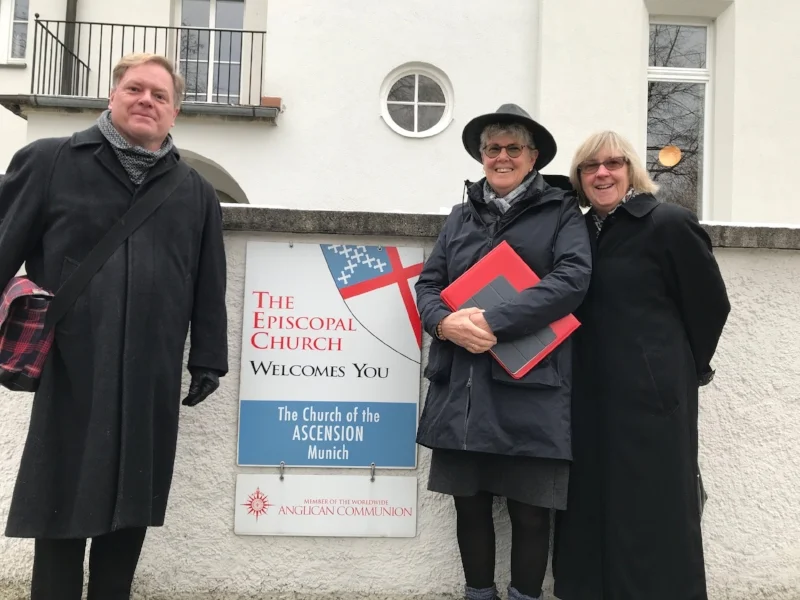
The Rev. Steven Smith, Tracey and Emily outside the Church of the Ascension, Munich
Excerpts from a sermon preached at Church of the Ascension, Munich, Germany
December 3, 2017
The season of Advent is often associated with words like waking, waiting, watching, hoping and longing. These actions often emerge in the dark. Human life is conceived in the dark of the womb, spring is born in the dark of winter, and spiritual life is birthed in the darkness of the soul. Advent is a counter-cultural season when we are encouraged to sit in the stillness, listen in the quiet, watch in the darkness, and wait with longing and hope for God to break into our lives and the life of the world.
With all due respect to Handel and Bach, I think that Advent is best expressed by singing the blues. An ancient blues singer – the prophet Isaiah – laments on behalf of his beloved people to their beloved God.
Second Isaiah (as it is known) was probably written in 6th century BCE, at a time when the Persians had conquered the Babylonians and the previously banished Judeans had returned home to Jerusalem after 50 years in exile. Both the returning, former elite and the largely peasant class who had remained behind both found themselves disenfranchised and disconnected.
The people lamented, crying out to the God of their covenant, expressing a combination of anger, frustration, disillusionment, longing and hurt.
You know this mood. You know that “Why me, oh Lord” feeling. Perhaps, you experienced it at the death of a loved one, the end of a relationship, the loss of a job, the discovery of a serious illness, or the acknowledgment of a psychic wound. Maybe you know it now in your fear of violence and terrorism, your concern for our fragile earth, your worries over the state of the economy, or your unease about the future of the European Union, the Middle East, or the United States.
Most of us, in our own way, have probably been there before (and we’ll go there again). It is that place of hopelessness, that awful place of waiting – waiting for the awfulness to end and trying to understand why it happened anyway.

The Monastery Greenhouse at Sankt Ottilien, Bavaria, Germany
I have come to understand more profoundly what’s it’s like to sing the blues in the presence of God. Last year, after receiving devastating news that I had early stage dementia, I was stunned. Like many people who receive a terminal diagnosis, I found myself in a season of relief, grief and escape. Both Emily and I played our song of a lament – like a favorite, but broken record – over and over again.
By giving myself permission to acknowledge the devastation that I was feeling, I allowed myself to grieve, lament and begin the process of dying to the life I had always known and being reborn to something new. Through my lament – my crying out to God – through facing my own Good Friday head-on, I came to a new place in myself.
Even though I knew that this wasn’t going to be a fun ride, I wanted and needed to live what I had been preaching for over 30 years: out of pain comes joy, out of brokenness comes wholeness, and out of death comes new life.
Lament is good for the soul. It’s even biblical. When we lament, we don’t have to preface our cry by, “I know I shouldn’t feel this way, but…” For we should feel this way when we feel this way. Life is not all sugar and honey. To say that everything is great when it is not is a lie; it’s an untruth, and it’s not fair. Lament is a form of honesty, a speaking of truth in love.
When we lament, when we sing the blues to God, our troubles do not magically vanish. However, our vision is lifted beyond our human hopelessness and life, and the waiting game becomes more manageable and meaningful.
Advent is a good time for singing the blues. It’s a lot like writing, painting, music or, as Isaiah suggests, making pottery. You take the clay, paint, words or music – and throw it, pound it, mold it, pinch it, stretch it and shape it. You might build it up, break it down and start again, and again, and again. And eventually, you start creating something beautiful with it.
So this Advent, try singing the blues, writing a poem or a prayer, painting a picture, or making a piece of pottery. In doing so, awake from your slumber and arise to the dawn of your own life, naming those things in the recesses of your soul that are blocking new birth, keeping God at a distance, numbing the psyche, and imprisoning the soul.
And when you’re finished with your lament (at least for the time being), be still, and listen for the response of God deep within you. You’ll be amazed at what you see and hear, and what you touch and feel. - Tracey
Caring for 'the least of these'

Holiday lights in Brussels
Excerpts from a sermon preached at All Saints' Episcopal Church, Waterloo, Belgium
November 26, 2017
The power of Matthew 25 resides in a very deep place in my soul. Jesus instructs his followers to feed the hungry, welcome the stranger, clothe the naked, care for the sick, and visit those in prison; and to realize that when we extend such kindness to another, especially the least of our sisters and brothers, we offer it to Christ himself.
Now Jesus’ words are taking on new meaning for me for as I become a member of the dementia community – a group of people that society often overlooks, dismisses, ignores, and treats as “one of the least of these.”
Below is an adaptation of Matthew 25 – written from the perspective of someone with dementia living in a memory unit:
“Then the King will say to those on his right, ‘Come, you who are blessed by my Father; take your inheritance, the kingdom prepared for you since the creation of the world.
For I was waiting for my meal while the care staff were quietly feeding others and you picked up a spoon to help me eat; I was thirsty – I had spilled the juice earlier – and you took the beaker and helped me to hold it to my mouth; I was a new resident, unknown to you, yet you smiled the smile of peace and acceptance; I had pulled my skirt up above my knees and you helped me preserve my dignity by gently pulling it down and straightening it around my waist; I was shouting for help across the room and you came and touched my hand and blessed me; I felt I was in a prison – the locked doors, a final barrier to my freedom, and you came to reassure me that this was my home where others worked to help me, not their workplace where I was an inconvenient intrusion; I was confused and stressed and you played music to me, you read to me, you showed me pictures and laughed with me.’
Then the righteous will answer him, ‘Lord, when did we see you in such a state of distress and respond in practical compassion?’
The King will reply, ‘I tell you the truth, whatever you did for one of the least of these broken people of mine, you did for me.’”
So, go and do likewise. - Tracey
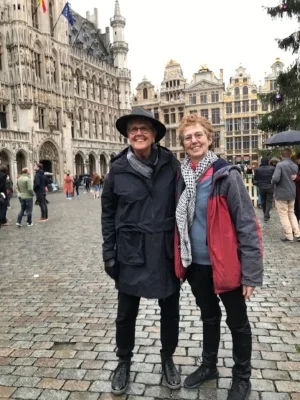
Tracey and Sunny Hallanan, the Rector of All Saints' Episcopal Church, Waterloo