A prayer for courage this holiday season
Today is December 2, the first Sunday in Advent and the first night of Chanukah. It really does seem that time is flying by like the migrating birds outside my window.

It has been said that time seems to accelerate as one gets older. According to researchers, it has something to do with perception and relativity. I’m experiencing it, but I can’t comprehend it.
There are a lot of things that I can’t comprehend these days: how migrating birds can figure out where they’re going; how the brain works; how some people can be so cruel, and others so kind; and how come I always lose one piece of every puzzle.

Maybe I don’t have to comprehend it all. Maybe I can just receive the mysteries of life with gratitude and grace.
On Friday, I spoke at the City Club of Cleveland. This venerable forum of public speech was filled with friends, colleagues, parishioners, neighbors, and strangers; and many more were listening on the radio or watching through the live stream. I spoke about dementia from the inside out, sharing my story and the life lessons I’ve learned over the past two years. It was a strange homecoming.
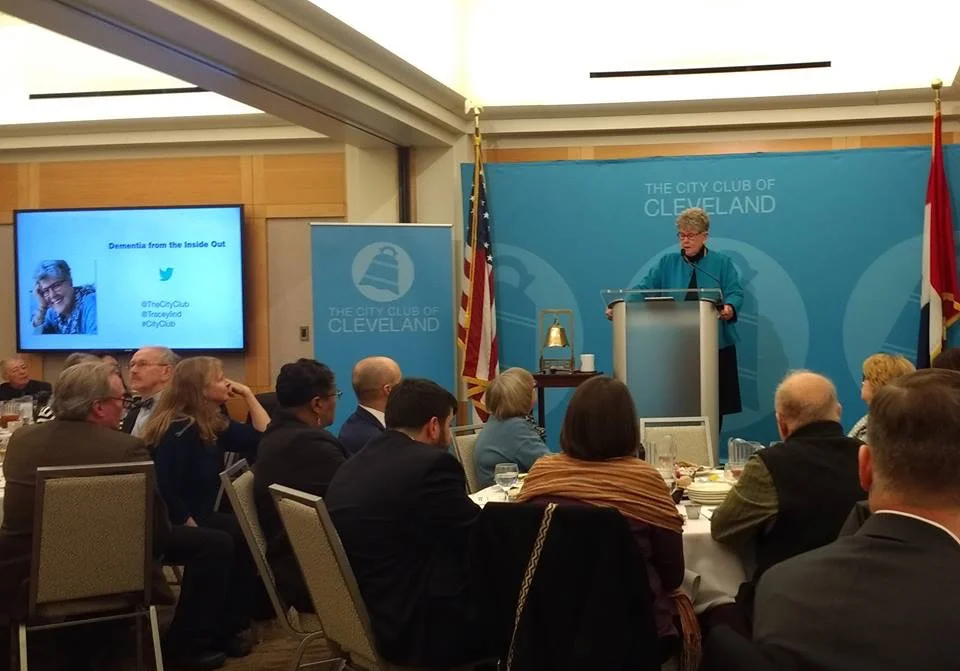
People tell me that I’m transparent, vulnerable, and courageous for publicly acknowledging and talking about my dementia.
I’m being transparent and vulnerable because I feel called to share this journey with others in an effort to demystify and destigmatize it - to demonstrate that there can be a rich and full life post-diagnosis. I believe that preachers are called to live our lives out loud, making sense of them through the sacred text, and in doing so, helping others to make sense of their lives.
But courage? I don’t get it. I don’t comprehend the risk of speaking about my dementia. I really don’t have anything to lose. I voluntarily stepped down from my job, and I’m not going to lose Emily or my family. If I lose any friends because of my dementia, then they weren’t really friends. And most importantly, speaking this truth won’t advance my dementia, at least I hope not. In fact, I think its good for my brain.
I’m fortunate. I know people living with early onset dementia who lost their jobs before they were able to retire or get disability. I know people whose spouses, families and friends abandoned them in their time of need. So yes, I’m one of the lucky ones.
But there’s more to it. When I go to the essence of that word “courage,” what people are saying to me begins to make sense. The root of the word “courage” is “cor,” which in Latin means “heart.” So to be courageous is to speak the truth from one’s heart. That is what I am doing. That is what Emily is doing. We’re speaking about dementia from the inside out - straight from the heart. So maybe we’re both courageous.


What would the world would be like if we all were courageous and spoke from the heart? I think it would be a beautiful place - the realm of God on earth.
So as I light my Chanukah and Advent candles this year, I’m going to start praying for everyone to be courageous and to speak truth from their hearts. God knows, that’s what the world needs now. - Tracey

If you want to listen to my City Club Forum, you can find the link here.
Born in the Night

Excerpts from a sermon preached on Nov. 18
St. Thomas’ Church, Whitemarsh, PA
Elie Wiesel has said, “The paths of the soul, overgrown, often know only the night, a very vast, very barren night, without landscapes.”[1]
Most of us have experienced such long, dark, frightening and lonely nights invaded by disturbing dreams that awaken us in a puddle of sweat with the sheets tangled around our exhausted bodies, not certain of where we are, unable to fall back asleep, afraid to return to our dreams, afraid that we’ll never awake, or if we do, that the day will be worse than the night.
And yet, “The most glorious works of [human beings] are born of the night.” This prophet knows of what he speaks. Wiesel lived through the very long night of the Holocaust.
When I was a little girl with a vivid imagination, I frequently had dreams – actually nightmares – about what today I would call the end-times: concentration camps, nuclear bombs, devastating fires, unrelenting floods, famines, droughts and horrible wars. I had dreams of long lines of people marching off into nowhere, wandering around lost and confused in the midst of ruins, walking on the long, dismal highway that Cormac McCarthy vividly described in his 2006 novel, The Road.
In my dreams, I was always trying to survive and trying to figure out what to do to make the situation better.
The dreams went on for years. Finally, as a young adult, they got so bad that I couldn’t sleep. And so, with fear and trembling, I sought help from a Jungian analyst. For a while, the dreams got even more terrifying.
Largely, because of the dreams (and my work at understanding them), I began the ordination process and entered the Union Theological Seminary in New York City. And, because of the dreams (and the journey they demanded), I went to work for the Episcopal Church in the South Bronx.
The South Bronx of the early ’80s enfleshed the landscape of my dreams. My parish was in a neighborhood then called Fort Apache. There were bombed out buildings and pockmarked roads and sidewalks. Devastating fires raged day and night. When it rained, it usually flooded; when it snowed, the streets were impassable; when summer came, the little that was green turned brown.
In the midst of all this devastation, I not only survived, but I thrived. And I met lots of amazing people living there, surviving, thriving and working to make the neighborhood a better place to live.
Living, working and praying in the landscape of my nightmares, I found myself becoming who God was calling me to be. And, as I discerned and tested my vocation, the wounds of my childhood nightmares were being healed.
However, my Spirit was angry. How could our society allow this kind of devastation and despair to continue? How could people put blinders on their eyes: looking straight ahead as they drove on the Cross Bronx Highway, praying that their car wouldn’t break down until they crossed the Westchester County line? With a new sense of passion and concern, I found myself – in my enthusiastic but adolescent faith – asking hard questions about economic and social justice and God’s sense of righteousness.
One day, I came across a new display of graffiti art. I stopped dead in my tracks and stared at the creation in front of me. On the wall of the local library was printed in large, bold, and colorful letters the word HOPE. It was like a burning bush, in the middle of the wilderness, commanding my attention, demanding my notice, telling me to stop and take off my shoes, for I was standing on holy ground.
There, in the midst of decay and despair, was the word of a brave new world – HOPE. But for what, I wondered? Did this graffiti speak of hope for the library and the children who sought refuge, recreation, and reading in its walls, hope for the adults who came there to relax and dream, and the elders who found it a safe place to sit and remember? Or was it hope for the neighborhood that still had a library, hope for the future of the community, or perhaps, hope for a life outside the South Bronx?
Once I saw the graffiti on the wall, my perspective changed. If some young graffiti artist could hope for this place, so could I. In fact, the hope of that graffiti artist demanded a response of hope from me. It was like a ram’s horn bidding me to see this community from God’s perspective and to act accordingly. Those four letters spray-painted on a public library offered me a glimpse of God’s dream for a city on the hill and called me to be a part of that dream. On that holy day, the nightmares finally ended, and my life’s work began.
Some thirty years, I’m learning to live with hope in spite of a life affected by dementia. Moreover, all around me, I see signs of great tribulation: fires in California, floods in North Carolina, earthquakes in Indonesia, wars in the Middle East, and gun violence in American cities. Yet, I am now convinced that creation is born out of destruction, brokenness begets wholeness, pain is the birth pang of joy, from death emerges new life.
In the words of St. Paul’s letter to the Church in Ephesus, “Our hope is in God whose power, working in us, can do infinitely more than we can ask or imagine.” (Ephesians 3:20)
Hear those words: “Our hope is in God whose power, working in us….” “Our hope is in God….working in us….” “Our hope is God…in us” It is a dream far greater than we can ask or imagine.
God has dreams for all people, perhaps most especially those living in the dark night. But it is up to us, even in the darkest of nights, to hold fast to the confession of our hope without wavering. In doing so, we provoke and encourage one another to love and good deeds. And then, God, whose power, working in us, will do infinitely more than we can ask or imagine.
_______________________________________________________________________________
[1]Elie Wiesel, “Out of Despair.” This paper was read at the Karen Horney Thirty-Fourth Annual Lecture in New York on May 7, 1986. It was published in The American Journal of Psychoanalysis, Volume 50, No. 2, 1990.
Come Out of the Grave and Live

For two years, I’ve intentionally read scripture through the eyes of dementia. It’s an interesting perspective.
A couple of weeks ago, as I was preparing to preach at St. Matthew’s Episcopal Church in Louisville, Kentucky, the gospel reading appointed for the day (John 11:32-44) spoke powerfully to my heart and circumstances, so much so that I wanted to shout, “God, you’re talking to me.”
It’s the story of Jesus calling his dead friend Lazarus to “come out of the grave.” I have been Lazarus, and Jesus called me out from the grave — at least twice.
Chapter 1:
As you most of you know, two years ago, I was diagnosed with early stage dementia, which caused me to take early retirement. After I finished my work at Trinity Cathedral, we needed to get out of town for a while. My dear friend Lucinda Laird invited us to come to Paris for Easter. We traveled by way of a transatlantic, repositioning cruise.
For nearly 4,000 nautical miles, I tried to come to terms with it all. By the end of the crossing, I found myself repositioned. I was ready to face this new chapter, which I thought would result in a slow but steady decline and an early death.
On Easter morning, in The American Cathedral in Paris, when Bishop Pierre Whalon preached Christ is risen and we rise, with tears in my eyes, I found myself rising in my front row seat. However, at lunch, when the Bishop asked what I wanted to do with this chapter of my ministry, I thought: What ministry? I’m getting ready to die.
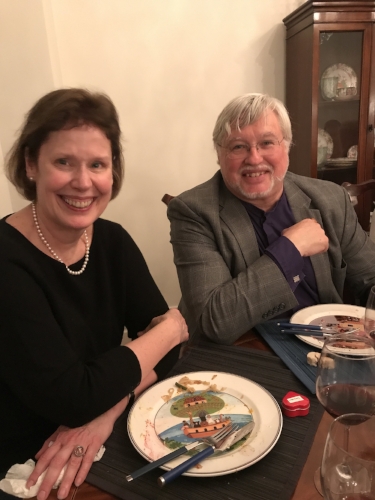
Lucinda Laird and Bishop Pierre Whalon
Both Lucinda and Pierre weren’t willing to accept that answer, and so, they pushed me a bit. After a long silence, I replied that I want to continue to preach and teach. I want to travel, play music, write and take photographs. I also want to explore the spirituality of dementia and help de-stigmatize this dreaded disease by speaking about it from the inside out.
Lucinda, in her exuberant fashion, invited us to visit Paris in the fall and live in the cathedral tower guest apartment (62 steps up). The Bishop suggested we preach and teach about dementia during a tour around The Convocation of Episcopal Churches in Europe. How could we refuse such a generous offering?
For months, I prayed for help, and on Easter morning, I received it. God wasn’t finished with me, but instead met me in my sadness, fear, anger, grief and despair, guiding me as I adapted to this new reality, searched for a new sense of purpose, and discovered a new chapter of ministry.
Over the summer, I tried to figure what I might have to say about the spirituality of dementia. A friend suggested I read the scriptures through the lens of dementia, and I would know what to say. It was good advice.
Chapter 2:
At first, I was a woman on an urgent mission. After all, time was running out. But then, I had a dream. My old friend, Damon Miller, now an integrative doctor in California, visited me in the night and told me he had something important to say to me. I awoke and sent an email, telling him about the dream and suggesting that we might meet on an upcoming trip to California.

Dr. Damon Miller and me
We had breakfast on Ash Wednesday (of all days). Damon suggested that while I had dementia, I might be able to slow, and perhaps even reverse, its progression. He explained there is new research about how modifications in stress management, diet, sleep, exercise, mindfulness practices (like meditation and yoga), chemical detox and supplements can make a huge difference. He suggested I return for a week of work with him, and in the meantime, I should give up gluten. Wow! That was a lot to ask, but it was the first day of Lent, so right then and there, I gave up gluten as a Lenten discipline and have not eaten it since.
Emily and I returned to California on Palm Sunday, and I spent Holy Week working with this incredible doctor. We went to Easter services at Grace Cathedral in San Francisco. And once again, sitting in the front row (one of the benefits of being a retired cathedral dean), on what coincidentally happened to be April Fools Day, I heard the voice of God say: “Tracey, you don’t have to die; you can live with dementia as a chronic condition.” Once again, with tears in my eyes, I accepted the invitation to come out of the grave.
Twice on Easter, I’ve been called to new life. And twice, I’ve had to figure out how to respond to God’s generous invitation.
So I ask you: How has God called you out of the grave? How did you respond? And what grave might God be calling you out of today?


An Election Day Anniversary
Today is a special anniversary. On Election Day two years ago, Donald Trump was elected president, and I was diagnosed with early stage dementia (Frontotemporal Degeneration). Upon hearing the news, a little boy in my congregation said to his mother: “Maybe it's a good thing Tracey has dementia so she can forget that Donald Trump is our president.”
Unfortunately, FTD doesn’t work that way. While I can’t reverse the course of my dementia, perhaps, on this Election Day, we can reverse the course of our nation. Please VOTE!
Remembering What Matters

AFTD Hope Rising Gala
When I was a little girl, going out to dinner as a family was part of our regular routine. To this day, I can recall those long-gone Columbus restaurants: Marzetti’s, Maramor, Ft. Hayes, Clarmont, Kahiki, and Desert Inn.
One evening, we went to our family’s favorite — Kuenning’s on North High Street. I probably ordered my favorite roast beef (medium rare), mashed potatoes, some vegetable (probably peas) out of the can, and salad. I still remember that salad dressing. Anyway, we had a lovely meal with reasonable conversation for two tired adults and their kids who were probably kicking each other under the table.
Between dinner and dessert, my mother went to the Ladies Room to “powder her nose.” She returned fuming. She sat down, and with tears forming in the corner of her eyes, in a hushed tone, scolded all three of us.
“How could you?”
How could we what?
“How could you let me leave the house this way?”
What’s wrong? You look great to us.
“Don’t you ever look at me?”
Sure. We see you every day.
“How could you let me leave the house with a clip in my hair”
Oh my God….
There it was — a big, old, aluminum hair clip — the kind the hairdresser used when cutting and styling. It had been sticking out the side of my mother’s head, holding her wave in place. And we had not noticed. Of course, my 10-year-old brother didn’t notice. He didn’t notice anything besides his basketball, tin soldiers, and whatever show was on television in the family room.
I hadn’t noticed. I was probably too absorbed in my own pre-teen drama. And dad — well, he should have noticed, at least according to my mother.
The evening was over. I don’t think anyone (except maybe my brother) ate their dessert. And there certainly was no lingering over coffee. We left our favorite restaurant and drove home in silence.
When we got back to the house, mom went into her bedroom, slammed the door, and that was the end of the night.
It’s funny when I think back on it. I always loved watching my mom get dressed for an evening out. She would carefully select her outfit, making sure everything matched and her stockings had no runs. She would then stand in front of her dresser mirror and carefully apply her Estée Lauder makeup — a little foundation, mascara, eye shadow, eyebrow pencil, blush, and lipstick. She would brush her beautiful blond hair. And finally, she would spray on some Estée Lauder perfume. That smell still brings me back to my childhood.
So…fast forward 50 years. I’m getting ready for the AFTD Hope Rising Gala at the Pierre Hotel in New York City. I’m the keynote speaker.

Familiar face at the AFTD gala
I shower and carefully dress, putting on my best outfit — a beautiful Nina McLenore jacket given to me by my friend Cindy Halle, a new pair of black skinny pants, low-heeled black dress shoes, and my mother’s pearls. I apply my makeup — a little blush and lipstick (after all, it’s a dressy gala). I spray on my White Shoulders perfume, which I’ve worn since I was 15 years old. I twirl for Emily, who tells me I look beautiful. And by the way, she looks stunning in her black evening wear. And off we go.
We take the elevator from our room on the 5th floor to the ballroom, which had been transformed from a meeting room earlier in the day into an elegant dining room ready to receive some 500 guests. People start to arrive — some of New York’s most elegant men and women, including gala chair Donald Newhouse, co-chairs Anna Wintour and David Zaslav, the evening’s host Paula Zahn, and our honoree Leonard Lauder. I’m feeling a little self-conscious, but what the heck, I’m the keynoter. Lots of photos are taken on the red carpet.
The room is packed. The lights are dimmed. I’m introduced. James Taylor (on a recording) starts singing “The Water is Wide,” and I walk out. I deliver a good speech. I even get a long standing ovation. I walk back to the table, have a sip of wine and eat a bit of dinner. The evening continues. At 9 p.m., we excuse ourselves and return to our hotel room.
I walk in and realize that my earrings and scarf (so carefully selected to finish off the evening’s attire) are sitting on the dresser. And nobody noticed — not even Emily. I laughed, and said, “Well, what can you expect. I have dementia.”
I then recalled that evening so long ago. I gave thanks for my mom who, with grace and dignity, valiantly lived and died with Alzheimer’s. I gave thanks for my dad, who loved my mother to the moon and back and felt terrible that night for not seeing anything but her stunning beauty — not even a hair pin. I gave thanks for my brother, who grew up to become an executive in the fashion industry, spending the majority of his career with Neiman Marcus. I laughed and gave thanks for a memorable evening and for all those generous donors who raised $1.9 million in one night to advance the work of AFTD.